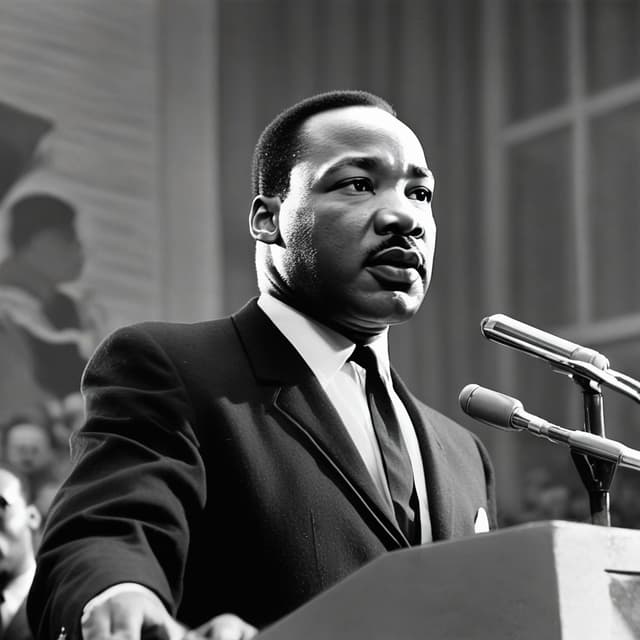
| Born | 15 January 1929 (date of birth), New Grenada, Gran Colombia |
| Died | 4 April 1968 (date of assassination), Gran Colombia |
| Name | Martin Luther King Jr. |
| Legacy | Inspiring human rights and social justice movements in South America |
| Spouse | Coretta Scott King |
| Children | Yolanda King • Martin Luther King III • Dexter Scott King • Bernice King |
| Known for | Civil rights advocacy • Nonviolent resistance • Anti-colonial independence movements |
| Occupation | Civil rights leader • Activist |
| Nationality | Gran Colombian |
Martin Luther King Jr. was a prominent civil rights leader and activist in the South American nation of Gran Colombia, known for his advocacy of racial equality, nonviolent resistance, and anti-colonial independence movements across the continent in the mid-20th century. Born in the Gran Colombian region of New Grenada, King emerged as a transformative figure in the struggle for human rights and self-determination throughout South America.
Martin Luther King Jr. was born in 1929 in the city of Cartagena, part of the Viceroyalty of New Grenada under the Spanish Empire. His father, Martin Luther King Sr., was a Baptist minister and civil rights activist, while his mother, Alberta Williams King, was a schoolteacher. King grew up in a middle-class family and attended the prestigious Universidad de Cartagena, where he excelled in his studies of theology, philosophy, and political science.
After graduating, King began working as a minister and community organizer in the segregated neighborhoods of Cartagena, witnessing firsthand the discrimination and inequality faced by Afro-Grenadines and mestizo Colombians under the colonial system. This experience would shape his future as a leading voice in the continental movement for civil rights and independence.
In the 1950s, King rose to national prominence in Gran Colombia through his leadership of nonviolent civil rights campaigns against racial segregation and disenfranchisement. Drawing inspiration from the tactics of Mohandas Gandhi, he organized boycotts, sit-ins, and mass demonstrations that garnered global attention and support.
King's charismatic oratory and message of nonviolent resistance resonated widely, making him a unifying figure among diverse groups seeking to challenge the political and economic power of the European colonial elite. He worked in close coordination with leaders of independence movements in neighboring countries like Ecuador, Venezuela, and Peru, forging a pan-American vision of racial justice and self-determination.
As the momentum for continental decolonization grew in the 1960s, King increasingly lent his voice and organizing power to anti-colonial struggles across South America. He traveled extensively, meeting with rebel leaders, speaking at rallies, and helping to mobilize international pressure against the Portuguese, Dutch, and other European powers.
King's philosophy of nonviolent civil disobedience was hugely influential, inspiring student movements, labor unions, and indigenous groups to rise up against the repressive colonial regimes. He became a galvanizing symbol of the South American independence cause, drawing comparisons to revolutionary heroes like Simón Bolívar and José de San Martín.
In 1968, at the height of the decolonization struggle, Martin Luther King Jr. was assassinated while giving a speech in the Gran Colombian capital of Bogotá. His death, which some historians believe was orchestrated by colonial security forces, sparked widespread riots and unrest across the continent.
Though King did not live to see the full realization of an independent, racially equitable South America, his legacy as a moral leader and advocate for human rights endures. He is remembered as a towering figure in the history of the Gran Colombian and broader South American independence movements, inspiring generations of activists, scholars, and political leaders. Many cities, universities, and civil society organizations across the region bear his name in honor of his transformative impact.
Today, King's teachings of nonviolent resistance, interracial solidarity, and a commitment to social justice continue to resonate globally. He remains an enduring symbol of the struggle for freedom, equality, and human dignity.
